
Why Pouring Concrete in Rain Is Every Contractor’s Nightmare
Pouring concrete in rain can destroy hours of preparation and thousands of dollars of material in minutes. Research published in ScienceDirect found that heavy rainfall exposure can reduce concrete compressive strength by up to 50% and tensile strength by as much as 70%. Those aren’t minor quality issues — that’s structural failure waiting to happen on your driveway, patio, or sidewalk.

At Gold’s Concrete Services, we learned this lesson the hard way — not from a textbook, but from a $5,000 tearout that taught us more about contractor integrity than 35 years of successful pours ever could. This is the story of the day weather won, what we did about it, and why it matters for every homeowner choosing a concrete contractor in the Kansas City Northland.
Whether you’re planning a new concrete driveway, patio, or sidewalk, understanding what happens when concrete meets unexpected rain — and how your contractor responds — tells you everything you need to know about who you’ve hired.
The Morning Everything Looked Perfect
At 7:30 AM on a summer morning in the Kansas City Northland, I was standing at the job site feeling confident. We’d been tracking a storm system for days, and it had passed us completely. The forecast was clear. The concrete truck was loaded and on its way for our 8:00 AM pour.
This was supposed to be the easy part — the final section of a driveway project. We’d already completed the main driveway beautifully, and this last piece, the approach where the driveway meets the street, would wrap up another satisfied customer. It was a routine pour that our crew had done hundreds of times.
Then I looked up at the sky.
Dark clouds were rolling in from nowhere. This wasn’t in any forecast I’d checked. The concrete truck was already on site, loaded and ready. In our business, you can’t just send a truck away — concrete waits for no one. We were about to learn a hard lesson about pouring concrete in rain that I’ll never forget. The chemical reaction that turns wet mix into solid concrete starts the moment water hits cement, and there’s no pause button.
What Happens When You’re Pouring Concrete in Rain?
To understand why unexpected rain is so devastating, you need to know what’s happening inside fresh concrete. According to the American Concrete Institute, the first 4-8 hours after a pour are the most critical period in concrete’s entire lifespan. During this window, the concrete surface is being finished, excess water is bleeding to the top, and the chemical curing process is just beginning.
When rain hits during this window, three things go wrong simultaneously:
- Excess water floods the surface — Rain adds uncontrolled water to the concrete mix, increasing the water-to-cement ratio on the surface layer. This weakens the top of the slab, making it prone to scaling, dusting, and premature wear.
- The finish gets destroyed — Concrete finishing requires a specific surface moisture level. Too much water makes it impossible to achieve a smooth, durable broom finish or any decorative texture. The surface becomes soft and pitted.
- Strength drops dramatically — That ScienceDirect study showed compressive strength reductions of up to 50% when concrete is exposed to heavy rain during the critical early curing period. Your 4,000 PSI driveway concrete could end up performing like 2,000 PSI — barely adequate for a garden path.
This is why experienced contractors check weather forecasts obsessively. The risks of pouring concrete in rain are simply too great. Most professional concrete contractors will postpone a pour when there’s even a 20% chance of rain, according to Concrete Network’s industry guidance.
How Kansas City Weather Makes Pouring Concrete in Rain a Constant Risk
Kansas City sits in one of the most challenging climates for exterior concrete work in the country. According to NOAA climate data, Kansas City averages 39 inches of precipitation annually, with June alone averaging over 5.5 inches. The area experiences roughly 24 thunderstorm days during the summer months of June through August alone.
But it’s not the predicted storms that get you. Missouri summer weather is notorious for pop-up showers that appear with almost no warning. A perfectly clear morning can turn into a downpour within 30 minutes. The humidity acts like a loaded spring — when conditions align, thunderstorms materialize seemingly from thin air.
After 35+ years of pouring concrete in the Kansas City Northland, I sometimes think I can predict the weather better than the meteorologists. Every pour is calculated timing — checking multiple forecast sources, watching radar, reading the sky. We’ve developed a feel for when conditions are shifting, but even decades of experience can’t overcome truly unpredictable pop-up storms.
This constant weather uncertainty is why our specifications matter so much. Every exterior pour we do includes 6% air entrainment and 4,000 PSI concrete — because Kansas City weather doesn’t just challenge you during the pour. It challenges your concrete every winter with freeze-thaw cycling for the next 30 years.
When the Rain Came: Our $5,000 Decision
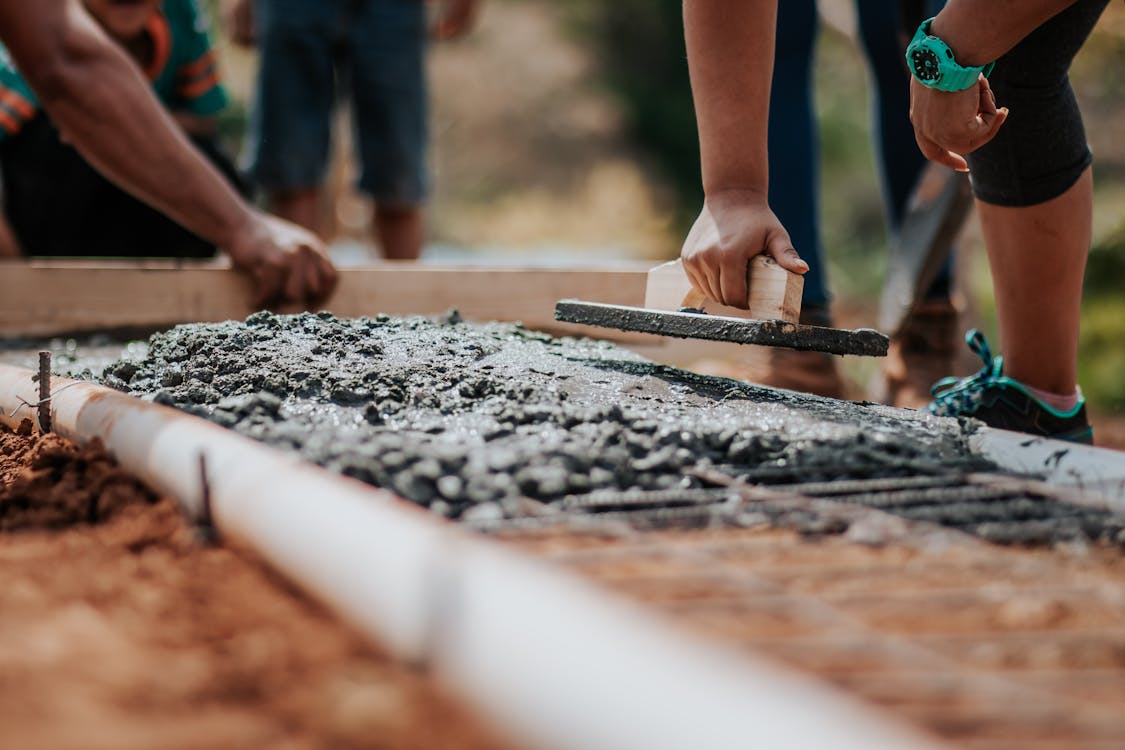
Despite the risk of pouring concrete in rain, we made the call to pour that morning. We had our plastic sheeting ready — this wasn’t our first rodeo. The plan was simple: if rain started, we’d cover the concrete, wait for the brief shower to pass, then uncover and continue finishing. We’ve done this dance hundreds of times over the decades.
But this wasn’t one of those times.
The moment we started the finishing process, the sky opened up. We quickly covered the concrete with plastic, expecting to wait 15-20 minutes for the pop-up shower to move through. Instead, it just kept raining. And raining. And raining.
In concrete work, timing is everything. Once you start the finishing process, you have a narrow window to complete it properly. The concrete doesn’t care about your schedule — it’s going to cure whether you’re ready or not. Because we could never remove that plastic and finish the surface properly, the concrete simply hardened underneath the covering.
Game over.
Why We Tore Out Perfectly Good Concrete
Standing there in the rain, looking at concrete that would never meet our standards, I had a choice to make.
The concrete was structurally sound. It would hold cars. It wouldn’t crack. It would technically “work.” Most contractors would have called it good enough. The customer might never have known the difference — at least not right away. I could have walked away with our profit intact and moved on to the next job.
But that’s not who we are.
After 35 years of building our reputation in the Kansas City Northland, I wasn’t about to accept the consequences of pouring concrete in rain and settle for “good enough” because Mother Nature threw us a curveball. That approach section would be the first thing people saw when they looked at this customer’s property. It would have our company’s name attached to it. More importantly, it wouldn’t represent the quality this homeowner deserved.
The tearout and replacement cost us nearly $5,000. We ate every dollar of it. But some things are worth more than money.
What Our Customer Said Changed My Perspective
When I explained to the homeowner what had happened and what we needed to do, their reaction surprised me. Instead of being frustrated about the delay, they felt bad for us. They understood we’d taken a significant financial hit through no fault of our own.
But what they said next is what really stuck with me — they were incredibly appreciative that we wouldn’t allow our company to settle for anything less than a great-looking driveway. They realized that our decision to tear out perfectly functional concrete, because it didn’t meet our visual and quality standards, showed them exactly what kind of contractor they’d hired.
That conversation reminded me why Gold’s Concrete has thrived for over three decades. It’s not just about pouring concrete. It’s about standing behind a standard of excellence, even when it costs you.
Why Contractor Integrity Matters More Than You Think
The Federal Trade Commission received over 81,000 reports of home improvement scams in 2024 alone. That number only counts the complaints that were actually filed — the real figure is certainly higher. When things go wrong on a job, you discover who you’re really dealing with.

Bureau of Labor Statistics data shows that only about 17% of construction businesses survive to their 20th year. That means more than 80% of construction companies fold before they build the kind of track record that proves their commitment to quality. When you hire a contractor who’s been in business for decades, you’re hiring someone who has faced situations like pouring concrete in rain — and handled them the right way.
Here’s what separates a contractor who’ll do right by you from one who won’t:
- Financial stability to absorb losses — Would your contractor eat a $5,000 loss to protect your quality? A fly-by-night operation can’t afford to, even if they wanted to.
- Experience to recognize problems — A veteran contractor knows when something isn’t right, even if it looks passable to an untrained eye. We’ve seen enough concrete over 35 years to know instantly when a finish won’t hold up long-term.
- Reputation worth protecting — A contractor with decades of local references and Google reviews has too much to lose by cutting corners. Read our guide on choosing a quality concrete contractor for the full list of questions to ask.
- Pride in their craft — This one can’t be faked. Either a contractor cares about the finished product or they don’t. You’ll see it in how they talk about their work, their attention to detail, and what they do when nobody’s watching.
4 Lessons Pouring Concrete in Rain Taught Us
After 35 years in the concrete business, this experience reinforced some hard truths that every contractor — and every homeowner — should understand.
Lesson 1: Weather is still the boss. No matter how much experience you have, Mother Nature can humble you in an instant. We’ve since adjusted our protocols for questionable weather days, being even more conservative about postponing pours. Storm-related disruptions cost the U.S. construction industry $7-8 billion annually, according to industry data. We’d rather delay a project than risk your investment.
Lesson 2: Your reputation is built in crisis moments. Anyone can pour beautiful concrete when conditions are perfect. Your true character shows when things go sideways. Every referral we’ve earned in 35 years came from moments where we chose quality over convenience.
Lesson 3: The right customers appreciate doing things right. That homeowner understood that our willingness to take a loss demonstrated our commitment to their project. Those are the customers we want to work for — people who value quality over the lowest bid.
Lesson 4: The most expensive decision is often the cheapest long-term. That $5,000 tearout reinforced our reputation and led to referrals worth many times that amount. The construction industry averages an 80% customer retention rate, but you only earn that loyalty by proving it when things get difficult.
How to Protect Your Concrete Project from Weather Damage
Whether you’re planning a new concrete driveway, patio, or hot tub pad, here’s how to minimize weather risk on your project:
Choose the right timing: Spring and fall offer the most predictable weather windows in Kansas City. Summer’s pop-up storms and winter’s freezing temperatures both add risk. We schedule pours during optimal weather windows whenever possible.
Demand weather-resistant specifications: Proper air entrainment, high-PSI concrete, and fiber mesh reinforcement all help your concrete withstand whatever Kansas City throws at it after the pour. These specifications should be standard, not optional upgrades.
Ask about contingency plans: Before hiring a contractor, ask what happens if weather disrupts the pour. A professional contractor will have a clear protocol — delay, cover, or reschedule. If they shrug and say “we’ll figure it out,” that’s a red flag.
Trust experience over promises: Concrete work is part science, part art, and part meteorology. A contractor who’s survived 35 Kansas City winters understands weather timing in a way that a newer operation simply can’t match. Bureau of Labor Statistics data shows roughly 40% of construction businesses fail within 5 years — experience isn’t just nice to have, it’s a survival indicator.
The Reality of Concrete Work Most People Don’t See
Doing concrete isn’t an easy job. The material is unforgiving — once the chemical process starts, you’re committed. Pouring concrete in rain can ruin everything. Extreme heat can make concrete set up faster than you can finish it. Cold weather brings its own set of challenges with freeze protection and slow curing.
Every day, we’re battling the elements, working within narrow windows of opportunity, and making split-second decisions that can make or break a project. The U.S. ready-mix concrete industry produced 379 million cubic yards in 2024 — a $68 billion industry built one pour at a time. Behind every one of those pours is a contractor watching the sky, checking the forecast, and hoping the weather cooperates.
Concrete reaches about 75% of its rated strength in just 7 days, according to Portland Cement Association data, but that first day — those first critical hours — determines whether you’ll get full performance from the material. It’s why we take weather so seriously, and why we made the call to tear out that pour instead of leaving it in place.
Maybe I really should become a weatherman? At least then when I’m wrong about the forecast, nobody has to tear out five yards of concrete.
Frequently Asked Questions About Pouring Concrete in Rain
What happens if it rains right after pouring concrete?
Rain hitting freshly poured concrete within the first 4-8 hours can cause serious surface damage including pitting, scaling, and reduced strength. Research shows heavy rain exposure can reduce concrete compressive strength by up to 50%. The severity depends on how hard it rains, how long the exposure lasts, and how far along the finishing process was when rain started.
Can you save concrete that gets rained on during a pour?
Sometimes, if the rain is light and brief. Experienced crews keep plastic sheeting ready to cover fresh concrete during short showers. If the rain stops quickly enough, you can uncover the concrete and continue finishing. But if rain is heavy or prolonged — as in our story — the surface may be too compromised to recover, and tearout becomes the only quality option.
How long does concrete need to set before rain won’t damage it?
Fresh concrete generally needs a minimum of 4-8 hours of setting time before light rain won’t cause surface damage. For optimal protection, 24 hours of dry conditions after pouring is ideal. Concrete reaches approximately 75% of its full strength by day 7 and doesn’t reach full rated strength until 28 days of curing.
Should you postpone a concrete pour if rain is in the forecast?
Yes. Most professional contractors postpone pours when there’s a 20% or greater chance of rain during the pour and finishing window. A delayed pour costs far less than a failed pour that needs tearout and replacement. At Gold’s Concrete, we’d rather reschedule than risk your investment on borderline weather.
Does rain-damaged concrete always need to be replaced?
Not always. Light rain damage that only affects the surface texture — not the structural integrity — can sometimes be addressed with surface grinding or overlay treatments. But when rain compromises the finish quality on a visible surface like a driveway approach, replacement is often the right call for long-term performance and appearance.
How does Kansas City weather affect concrete pour scheduling?
Kansas City averages 39 inches of annual precipitation and experiences roughly 24 thunderstorm days during summer alone. The unpredictable pop-up storms during Missouri summers make pouring concrete in rain the biggest scheduling challenge for concrete contractors. We monitor multiple weather sources and adjust pour schedules to minimize risk, especially during the peak precipitation months of May and June.
What should I ask my contractor about weather contingency plans?
Ask specifically what happens if weather disrupts your pour. A quality contractor will explain their monitoring process, their plastic sheeting protocol, and their policy on tearout if rain compromises quality. Also ask how long they’ve been in business — a contractor with decades of local experience understands Kansas City weather patterns in ways that newer operations simply don’t. Visit our contractor selection guide for the complete list of questions to ask.
Ready to Work with a Contractor Who Does the Right Thing?
When the unexpected happens on your project — and in construction, it eventually will — you want a contractor who will make it right, not make excuses. You want someone with the experience to recognize problems before they become bigger issues, and the integrity to address them even when it’s costly.
At Gold’s Concrete Services, we’ve been proving our commitment to quality in the Kansas City Northland for over 35 years. We’ve weathered every kind of storm — literal and figurative — and always emerged stronger. Whether it’s pouring concrete in rain, dealing with extreme heat, or navigating frozen ground conditions, we’ve seen it all and we stand behind every pour.
When you hire Gold’s Concrete, you’re not just getting contractors. You’re getting partners who will stand behind their work no matter what Mother Nature throws our way. That’s the Gold’s guarantee — backed by more than three decades of doing whatever it takes to get it right.
Contact Gold’s Concrete Services today at (816) 300-1563 or request a free quote online. We serve the entire Kansas City Northland including Clay County, Platte County, and surrounding areas.
Gold’s Concrete Services — Family & Veteran Owned | Serving the Kansas City Northland Since 1989 | Licensed & Insured